
Good Intentions Can Still Lose the Plot
One of the biggest lessons birthwork has taught me, and honestly one of the biggest lessons this season of the world seems to be asking of all of us, is that multiple things can be true at once. Something can be beautiful and flawed. Helpful and incomplete. Well-intentioned and still missing the bigger picture. I think we are living in a moment where we desperately want things to be simple. Good or bad. Right or wrong. But the deeper I go into this work, the more I realize how rarely life actually works that way.
I say this as someone who grew up doing global service and mission trips. I was that teenager who traveled abroad with church groups and volunteer programs. I loved it. I loved playing with kids at orphanages. I loved the feeling of being helpful, of being needed, of believing that my presence alone was making a difference. And I don’t feel shame about that younger version of myself. The desire to help was real. It was sincere. It came from love. But with time, and with returning to the same places again and again instead of just once, I began to see how incomplete that model often was.
At Wombs of the World, we are very intentional about not using the word “volunteer.” Not because volunteers are bad people, but because the word itself can carry a quiet power dynamic. I come, I give, I leave. Help flows in one direction. Impact is assumed instead of examined. The drop in - drop out volunteer tourism can actually be toxic for the communities, but make the traveler feel so good about themselves. This is something I have talked about openly with nurses and hospital directors here in Tanzania, many times over. Because I am constantly wrestling with it myself. Is it okay that our doulas come for a week and then leave? Does that do harm?
The overwhelming answer has been no. We are welcome welcome welcome and they love having the doulas here.
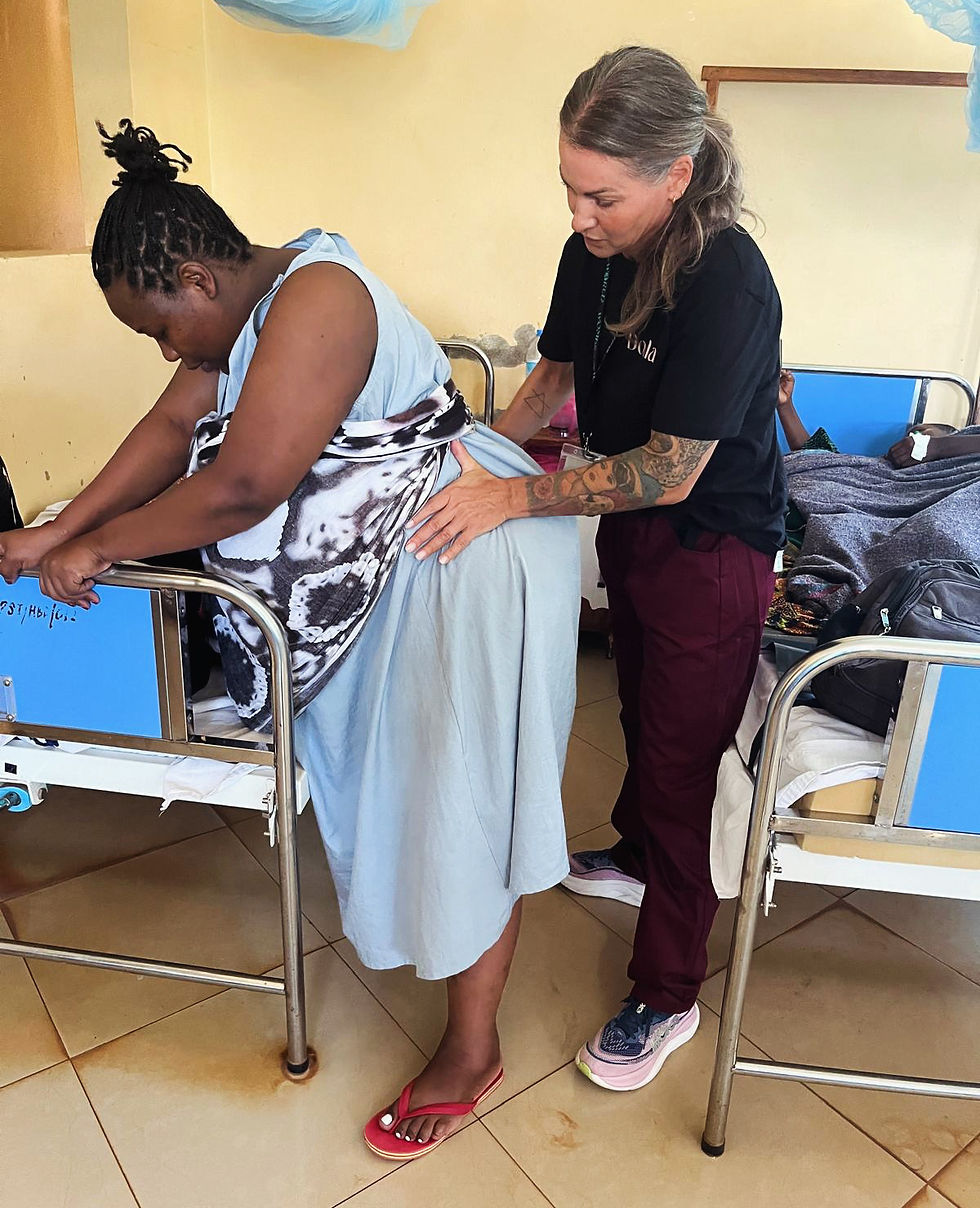
What we get to do here is different because we get to share a complete moment with a woman giving birth. Our participants support her labor. They stay present. They witness. And then that woman goes home. She does not live at the clinic. She returns to her life, her family, her community.
I tell our participants constantly that anytime an opportunity presents itself to shower the nurses with love, they should take it. Fill their cups to the brim. These nurses are the ones here day in and day out. They are the ones who will still be caring for mothers long after we leave. Any work that ignores that reality is incomplete.
This week, that truth showed up in a very tangible way. We happened to be here for the opening of a beautiful new eye facility at Karatu Lutheran Hospital, funded by a Danish NGO. It is genuinely stunning. A quarter-million-dollar investment. Clean, modern, fully equipped. The kind of building that immediately signals care, attention, and possibility. And truly, the pros far outweigh the cons. This clinic will help people literally see! That is amazing.
And yet, with all the best of intentions, it is missing the bigger picture.
There is currently no full-time eye doctor in the entire region. So while the building exists, the staff to run it does not yet. Perhaps it will attract one in time. I hope it does. But then there is another layer. There is nowhere in Karatu where glasses are made or repaired. So for the Maasai families or people coming in from surrounding areas, even if they are diagnosed and fitted, the systems to support ongoing care are not yet in place. The intention is beautiful. The generosity is real. And also, unfortunately, there is still so much that is missing the mark.
That moment affirmed why we have chosen to move slowly. Why we prioritize relationships over rapid development. Why we resist the urge to fix the most visible problem without understanding the ecosystem around it.
On our drive into Karatu with the group, there was a moment that captured this perfectly. The car in front of us suddenly slowed to a stop because large branches were scattered across the road. Our immediate reaction was confusion and frustration. Why would someone block the road like this? Our instinct was to get out and move the branches. To clear the problem. But as the car ahead carefully navigated around them, we saw what they were protecting. A broken-down vehicle sitting in the road. The branches were a warning. A locally understood signal to slow down so that oncoming traffic wouldn’t slam into a stopped car.
I could have moved those branches. I had the ability to do so. But in doing that, I would have removed the protection without understanding its purpose. That moment felt like a perfect metaphor for global health work. We see something that looks wrong. We rush to fix it with the tools we know how to use. But we don’t yet understand why it exists.
The first time I came to Tanzania in 2018, I saw problems everywhere. Things I wanted to fix. Solutions I was certain would help. And every year I return, I am humbled again and again and again. It has never been my intention to impose or to change culture or to “save” anyone. And at the same time, I hold an unshakable belief that every woman deserves respectful maternity care.
This is where the tension lives.
When we are here, we do witness practices that, through a Western lens, look like obstetric violence. Women being restrained. Mothers labeled as “uncooperative” for screaming, for moving, for refusing vaginal exams. And I want to be very clear. I do not believe these nurses are malicious. They are wonderful, hardworking people doing what they were taught in a system that is under-resourced and overwhelmed.
As someone said to me recently, it is much easier to perform a cesarean. It follows a protocol. A recipe. It is predictable. Managing an unpredictable, complicated vaginal birth requires tools many providers were never given. When trauma-informed care has never been taught, how could we expect people to intuit it?
I do have tools for so-called “uncooperative mothers.” They are called safety, consent, grounding, and presence. They are called doulas. But introducing those tools requires humility, cultural awareness, and deep respect for the fact that I am not the expert in this place.
What we can do, and what we do at Wombs of the World, is share frameworks. Offer education. Support nurses instead of shaming them. Bring in doulas not to replace anyone, but to complement the system. To reduce fear. To lower adrenaline. To increase oxytocin. To care for the caregivers as much as the mothers.
And the most important part is that this work is not happening in isolation. We are not alone in advocating for respectful maternity care. Around the world, organizations are pushing for dignity, consent, and trauma-informed systems. I just happened to land in Tanzania in 2018. And it stole a piece of my heart.
So here we are. Moving slowly. Listening deeply. Holding contradictions. Learning when to act and when to pause. Leaving the branches in the road until we truly understand what they are protecting. Because sometimes the most ethical thing we can do is not to fix, but to stay. If you would like to get involved and help support our work on the ground, please consider donating to the Wombs of the World Foundation. Thank you for reading.


Comments